Drone helps protecting wild animals
Increasing numbers of farmers and contractors rely on drone technology when it comes to fawn rescue. State-of-the-art thermal imaging cameras, combined with complex evaluation software and a cloud connection enable fast and highly effective detection of grass areas with a low error rate. Claas and thermal Drones jointly developed this new advanced technology. Time for […]
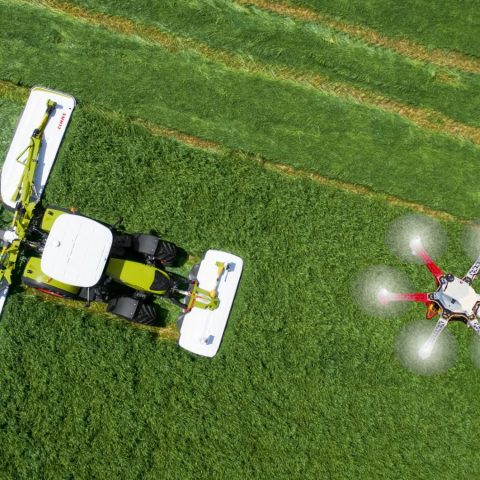
Increasing numbers of farmers and contractors rely on drone technology when it comes to fawn rescue. State-of-the-art thermal imaging cameras, combined with complex evaluation software and a cloud connection enable fast and highly effective detection of grass areas with a low error rate. Claas and thermal Drones jointly developed this new advanced technology.
Time for the first grass cut is always there somewhere around the world. This means that farmers and contractors will have to intensively address the topic of wildlife rescue. Drone-guided thermal imaging cameras, such as the system jointly developed by thermal Drones and Claas as part of the “Wildretter” (Wildlife saviour) project and successfully tested in broad practical use since 2019, have proven to be the most effective method for several years. “Several hundred users are now using our technology,” reports Dr Martin Israel, one of the founders of thermal Drones. “In 2022 alone, our drones were used for wildlife rescue on more than 10,000 hectares. There are also other areas that were scanned with drones that use our software.”
The results are impressive: 2,500 wild animals, around 90 percent of them fawns, were located and secured in 2022 alone. In addition to fawns, smaller animals such as pheasant chicks and hares are also successfully detected. Thanks to the special software POIStudio, reliable use is possible even when the midday sun is high in the sky and the temperature of the animal and the environment differ only slightly. “This operational reliability, together with the high effectiveness, is impressing increasing numbers of users, and demand is increasing rapidly,” adds Dr Martin Israel. “The amount of wildlife is high, especially in smaller sites with a lot of cover to the sides. In Bavaria and Baden-Württemberg there is an average of one fawn to every 4 to 5 ha, while in expansive areas such as Mecklenburg-Vorpommern it is 15 to 20 ha.
Fast, automated and precise
In addition to the high operational efficiency, easy handling is also another plus point for the system. Once the area boundaries have been marked on the satellite images, the drone automatically flies over the meadow at a height of around 50 to 80 m and at a speed of around 30 km/h. Alternatively, the drone can always be manually controlled. Areas of 20 to 30 ha per hour can be covered irrespective of how it is controlled. Every second, the thermal imaging camera saves photos with the associated GPS coordinates on an SD memory card; this is then evaluated. With the help of AI and contrast enhancement, the software recognizes where a fawn or other wild animal is in cover and marks these points graphically and with the exact GPS coordinates. The data can then be transferred to smartphones via a cloud connection, so that helpers can specifically head for the identified sites. The helpers actually find wild animals there with a success rate of 95 to 98 percent.
“You shouldn’t underestimate the psychological aspect either,” says Andreas Wetzel, Product Manager for forage harvest machinery at Claas Saulgau GmbH. “After detection, the drivers, farmers and contractors can drive onto the field with confidence and can concentrate better on their actual work with the tractor and mower – without fear of mowing down a fawn.”
Continuing to adjust the mowing strategy
“We recommend adapting the mowing strategy and thereby enabling safe escape routes for other wild animal species, even on meadows where detection has been carried out,” explains Andreas Wetzel. “Dividing areas by cutting down the middle and mowing towards the area boundaries has proven to be particularly effective. If the area is by a busy road, it should be mowed starting from the road into the site, so that the wild animals do not flee in the direction of traffic.”
The strategy of starting to mow the areas the evening before also promises success in deterring wild animals. This changes the wild habitat in such a way that the flight instinct is stimulated and in many cases a doe will lead their fawn out of the area. Sufficiently protected sites for the fawns should be available adjacent to this.