Yanmar Agri Co. has developed deep-planting cultivation technology to improve sugarcane productivity, while minimizing environmental impact. This technology was created in collaboration with the Japan International Research Center for Agricultural Sciences (JIRCAS). Following successful research outcome, Yanmar Agri is now launching full-scale sales of related products.

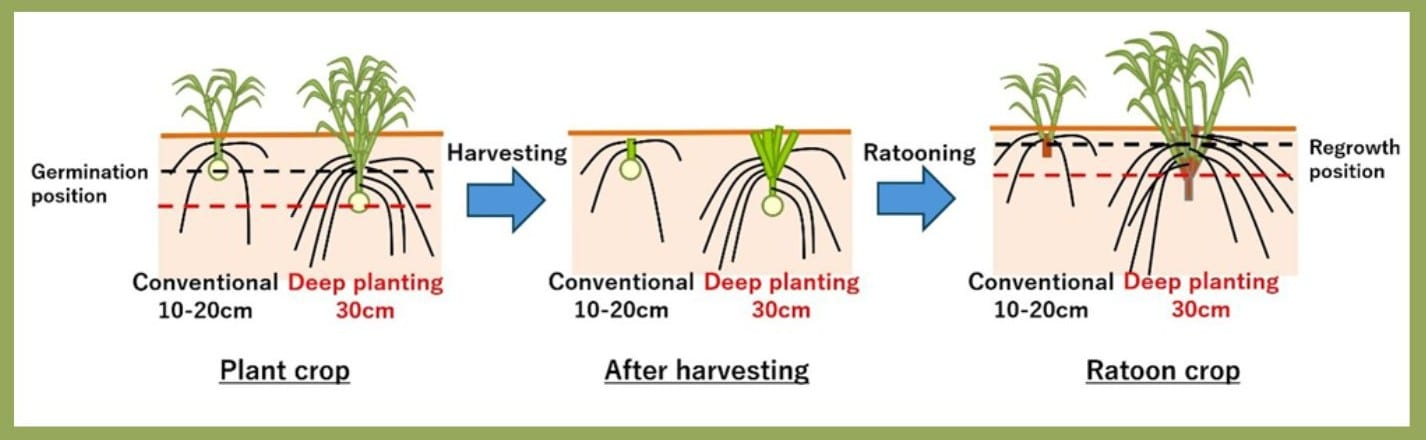
For the sustainable production of sugarcane, it is essential to maintain ratoon cropping, a high-productivity and environmentally friendly cultivation method, over an extended period. However, in ratoon cropping, the depth at which new shoots emerge from the underground stubble after harvest tends to become shallower, leading to lower yields and a reduced number of regrowth cycles. To address this issue, deep-planting cultivation technology was developed to increase the yield and longevity of ratoon cropping in the drought-prone northeastern region of Thailand.

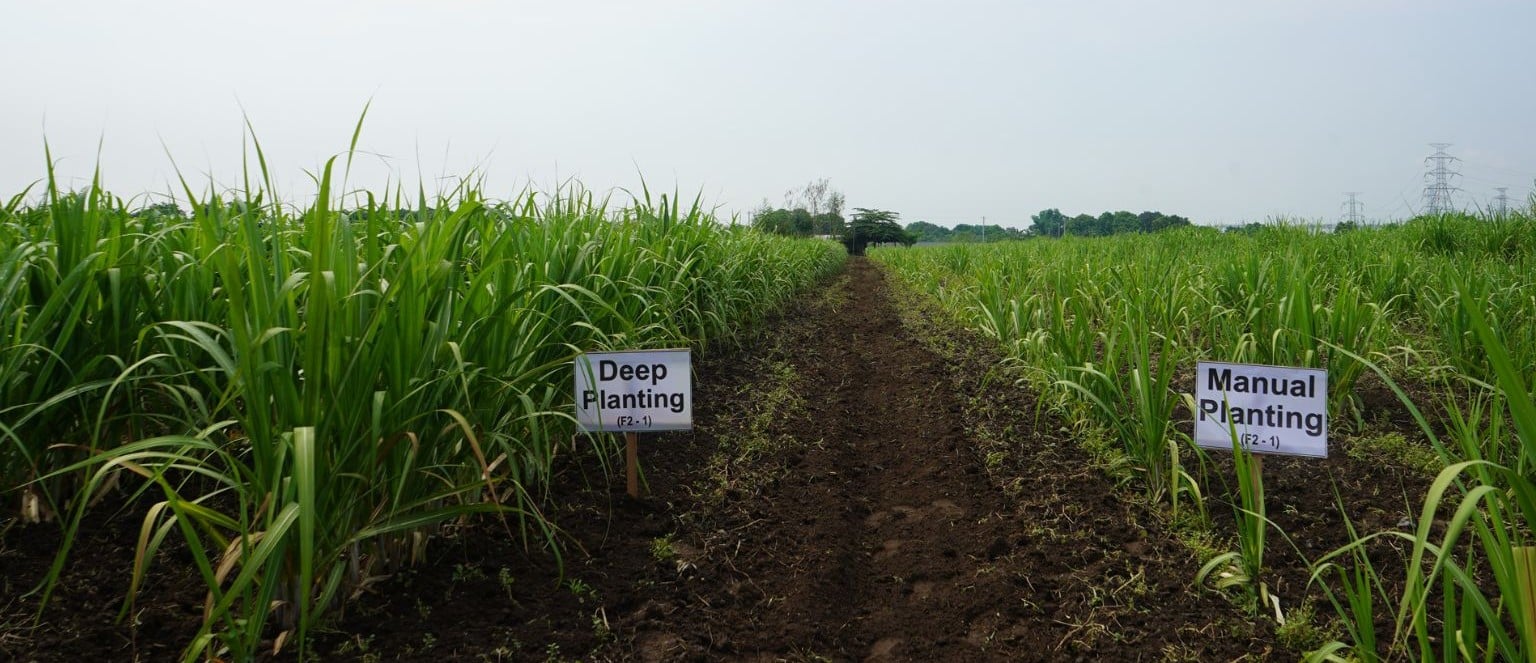
Deep-planting cultivation involves planting sugarcane at a depth of approximately 30 cm—deeper than the conventional planting depth of around 10–20 cm (see figure). In the Philippines, the effectiveness of this method for stable production during drought years has been demonstrated. Additionally, improved resistance to lodging*1 is expected to help mitigate typhoon damage.

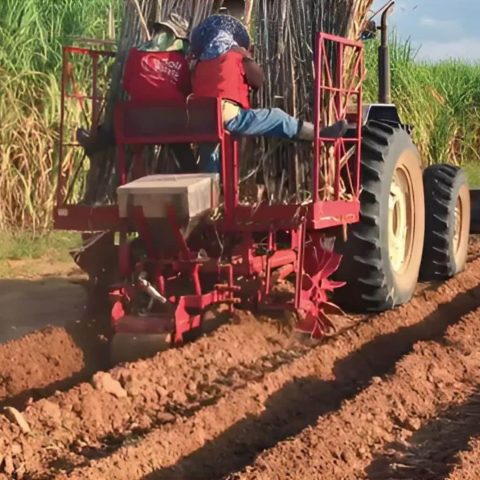
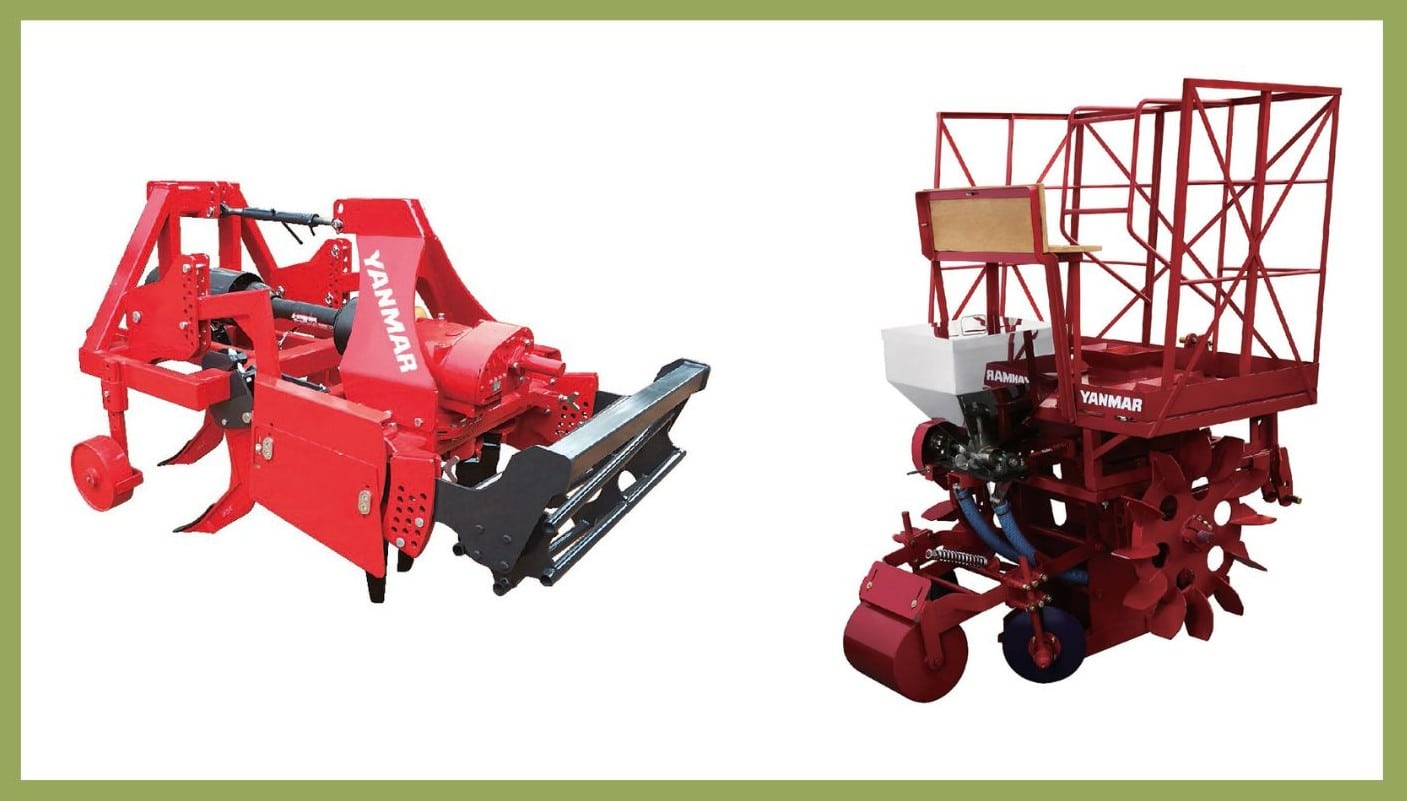
Currently, the Philippine Department of Agriculture’s Sugar Regulatory Administration is promoting block farming*2, a collective farming system for small-scale farmers. Based on the results of this research and development, Yanmar Agri is launching full-scale sales of subsoilers and deep-planting planters optimized for deep-planting sugarcane cultivation among block farming households in the Philippines. Furthermore, in Japan, demonstration trials for introducing this technology are being conducted in collaboration with a local sugar factory on Ishigaki Island, Okinawa Prefecture.


Yanmar Agri’s deep-planting technology supports the Yanmar Green Challenge 2050 by improving sugarcane productivity while reducing environmental impact. It promotes efficient land use, enhances resilience to droughts and typhoons, and minimizes resource consumption, aligning with Yanmar’s commitment to sustainable agriculture.

Left: combined subsoiler and power harrow *3 Right: sugarcane planter *4

*1: Lodging occurs when crop stems are displaced from the vertical by stem buckling or root displacement. This can be caused by factors like wind, rain, hail, or inadequate stem strength.

*2: Block farming is a policy in the Republic of the Philippines that consolidates small-scale sugarcane farms to promote irrigation and mechanization, thereby improving productivity and income.

*3: A subsoiler tills only the planting area and performs soil breaking, soil pulverization and leveling, and compaction in a single operation (compatible with tractors of 90 horsepower or more).

Highlights

“I wanted to disrupt the industry”

Craig Rupp is a self-made man. The founder and owner of US based Sabanto, has a clear vision on automation in agriculture. “I wanted to disrupt the industry,” he says. And so, he did. Craig developed the Steward retrofit kit, making tractors operate autonomously. It eases the workload for farmers. B...

“Agricultural robots” today at Agritechnica digital

“Agricultural robots” is the first topic in new webinar series on startup technologies, presented in Agritechnica digital. Free-to-attend ‘AgTech’ events explore topics shaping startup innovation scene: robotics, digitalization, circular economy and soil health. Today, 18 January 2022, Agritechnica ...

“Agritechnica Asia live” is approaching

From 24-26 August, Agritechnica Asia Live 2022 will be held in Can Tho City, Vietnam. At Agritechnica Live, machinery will be demonstrated in the field. Concurrently there’s an exhibition with a seminar programme. The previous edition was held in Myanmar, which attracted visitors from across South E...

“Let the future begin”

The global ag machinery market is continuously evolving. AGCO aims to be in the forefront of new technology. Serving their own customers, but also mixed fleet operations. With new solutions in precision ag, autonomous vehicles and engines running on clean energy. Always with full focus on the farmer...

“Cotton King” high clearance tractor

Kazakhstan, Kyrgyzstan, Tajikistan, Uzbekistan and Turkmenistan in Central Asia, are rich in cotton production. In order to meet technological constraints, Lovol launched the high clearance TX1104-H “Cotton King” tractor, specifically designed for cotton production in these countries. Th...

Related articles

Steyr advances hydrogen technology

TU Wien, Austria’s leading technology university in Vienna, together with Steyr and other project partners, has launched the HYTRAC hydrogen agriculture research project. This combines a hydrogen-powered tractor with on-farm hydrogen storage and refueling infrastructure, the so-called COMBHY. Object...

Research on low-carbon rice farming

Yanmar Diesel Indonesia, Faeger Co. and IPB University have launched a joint research project in Indonesia to assess the potential of combining Alternate Wetting and Drying (AWD) irrigation with biochar application to reduce greenhouse gas (GHG) emissions and stabilize rice yields. Indonesia is one ...

New Holland training center in Brazil

New Holland and dealership Nova Holanda inaugurated the New Holland training center, located at Cidade do Agro, the new education complex of the University of Agro | Uniube, in Uberlândia (MG), Brazil. The initiative is expected to benefit approximately 8,000 students. In the new center, New Holland...