Claas Shredlage technology beneficial for finishing bulls
Harvesting maize silage according to Claas Shredlage technology, has proved to be beneficial for dairy cattle. It also seems to hold benefits for raising and feeding finishing bulls. Since the launch of the “Shredlage” process in 2015 in Europe (2010 in North America), the benefits of intensive processing by the MCC corn cracker, combined with […]
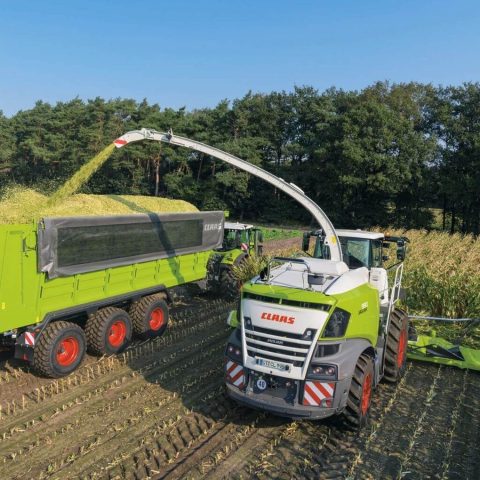
Harvesting maize silage according to Claas Shredlage technology, has proved to be beneficial for dairy cattle. It also seems to hold benefits for raising and feeding finishing bulls.
Since the launch of the “Shredlage” process in 2015 in Europe (2010 in North America), the benefits of intensive processing by the MCC corn cracker, combined with lengths of cut from 26 to 30 mm, have won over many dairy farmers. This technology results in maize silage with a high proportion of coarse particles of the residual plant accompanied by complete, intensive cracking of the maize kernels. Used as ruminant feed, Shredlage has a more physically beneficial structure and better digestibility than conventional short-chopped maize silage. The question of whether this process can also be applied to finishing bulls with the same positive effects and additional benefits with regard to fattening performance, animal health and carcass yield has been investigated in Germany for the first time in a trial conducted on a working farm in Münster-Amelsbüren.
Feed trial lasting 243 days
The 243-day feed trial conducted by Osnabrück University of Applied Sciences (Prof. Dr. Heiner Westendarp, Prof. Dr. Hubert Korte, Laura Bunk, Kilian Fenske) investigated how feeding with Shredlage compared with conventional maize silage with regard to the feed intake, daily gain, manure quality (digestibility), rumen pH and carcass yield of finishing bulls. In addition, measurements were performed at the cut face of both types of maize silage to establish the degree of compactability and reheating.
The maize was harvested by two forage harvesting teams at the beginning of September 2019. A Claas Jaguar 970, operating in throttled mode, was used to harvest the conventional maize silage with a MULTI CROP CRACKER (MCC) Classic L running with a 30% speed difference and a theoretical length of cut of 8 mm. The Shredlage was harvested by a Claas Jaguar 950 with the MCC Shredlage corn cracker at a 50% speed difference and a 26 mm length of cut. The chopped material was placed in a conventional clamp, the short-chopped maize silage filling one side and the Shredlage the other. Two Claas Xerion tractors were used for spreading and compaction. The short-chopped maize silage was compacted with a total rolling weight of 18 t while the Shredlage was rolled with the higher weight of 22 t in accordance with the greater length of cut and Claas recommendations.
Improved animal health and monetary benefits
Following an ensiling period of 11 weeks, the silage began to be fed to 72 Fleckvieh bulls. These had an average live weight of 382 kg at the beginning of the trial. The bulls were divided into two groups: the trial group received a TMR (total mixed ration) with Shredlage without straw while the control group was fed a TMR with short-chopped maize silage and straw. The rations differed only with regard to the length of cut of the maize silage, the addition of straw and the degree of isoenergetic supplementation with triticale, rye and grain maize. The trial ration and the control ration always had comparable energy and nutrient content.
The feed intake was measured and documented daily as a group mean value. In addition, all the animals were weighed on the 64th day of the trial and again on the 176th day. The rumen pH of six animals per group was measured using rumen boluses and recorded over 150 days of the trial. Manure washing was also performed on ten occasions in order to allow conclusions to be drawn about the digestibility of the rations.
Finally, on slaughter, the carcass weight as well as the conformation grade and fat grade were established and compared. The resulting carcass revenue was compared with the feed costs for the trial and control groups. This comparison took into account an extra 1.0 € cost per tonne of forage fresh mass (FM) for the Shredlage variant to cover the equipment fitted to the Claas Jaguar as well as the higher rolling weight and the greater transport capacity required.
Evaluation of all the data
* At 224 kg DM/m3 and 216 kg DM/m3 respectively, the short-chopped and Sherdlage variants were found to have almost the same degree of compaction in the clamp with no significant differences. This consistency in the compaction behaviour was also found in the critical upper layer of the clamp, where the respective figures were 183 and 181.9 kg DM/m3. These results demonstrate once again that, when subjected to an increased rolling weight, Shredlage can be compacted just as well as short-chopped silage.
*The animals in the short-chopped silage group had a mean daily intake of 10.5 kg DM while the corresponding figure for those in the Shredlage group was 10.2 kg DM of TMR.
* Live weight per animal on the 64th day of the trial was comparable in both groups at almost 480 kg. On day 176, at 648.6 kg, the weight attained by the animals in the Shredlage group was 7.4 kg lower than those in the short-chopped silage group, a difference which could not be validated statistically. There was no significant difference in the daily weight gain within the first 176 days at 1.55 kg for the short-chopped silage animals and 1.51 kg for the Shredlage animals.
* Despite their somewhat lower daily weight gains in the first 176 days, the Shredlage animals had a carcass weight of 402.9 kg, some 6 kg more than the corresponding figure for the short-chopped silage animals. However the difference was not significant. When it came to carcass conformation grading, the animals in the Sherdlage group averaged an R+ while those in the short-chopped silage group were graded R to R+. The Shredlage animals achieved a higher fat grade at 2+, as opposed to the short-chopped silage animals which tended more towards a 3- grade. The Shredlage group therefore tended towards a better conformation grade and its fat grade was significantly more favourable.
* Following manure washing, the upper and middle sieves contained fewer residues of the Shredlage variant than of the short-chopped silage variant. It can therefore be concluded that the digestibility of the ration was better – despite the greater length of cut.
* Measurement of pH values in the course of the day showed a higher level – which was favourable for fibre digestibility – in the Shredlage animals compared with the short-chopped silage animals. The higher pH values of the animals fed with Shredlage indicate a potential to reduce the incidence of acidosis and so to improve animal health.
* It was possible to do without feed straw in the Shredlage ration and therefore to achieve a further saving on feed concentrate.
* Monetary evaluation of the ensiling costs, feed costs and carcass yield resulted in added value of some 39 euros per animal in favour of the Shredlage variant.