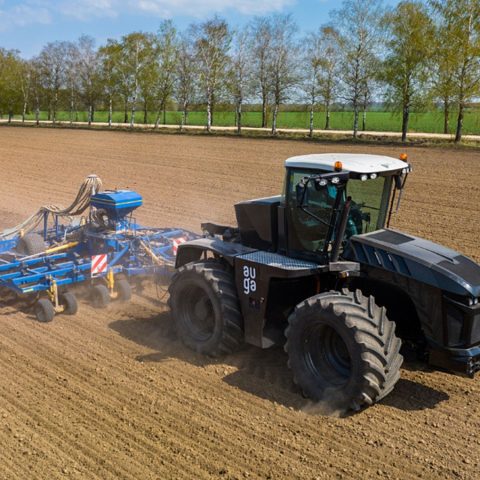
AUGA group, producer of sustainable organic food and developer of agricultural technology in Lithuania, discontinues further development of its M1 biomethane and electric tractor. The financial situation of AUGA Group, currently doesn’t allow continuation of this project.

The goal of AUGA Group is to ensure continuity of operations, the long-term solvency of the group of companies and fulfilment of commitments to creditors, according to an official statement. To achieve this goal, AUGA group is postponing its technology development plans indefinitely, including the M1,  and giving all its attention to activities that generate cash flow, namely, agriculture, biomethane production, and the supply of consumer end products.

“We have dedicated time and energy to seeking agreements with financial institutions regarding the deferral of long-term loans and the sale of some assets to avoid having to enter restructuring. We do not have a common agreement and achieving these goals requires additional time. So, to fulfil the obligations that we have and to protect our creditors, employees, suppliers, and other stakeholders, we are starting those proceedings. If some subsidiaries of AUGA group, AB fail to reach a solution with creditors, they may also need to undertake a restructuring process,” says Kęstutis Juščius, Chair of the Board of the AUGA group.

Over the past five years, AUGA group has faced challenges. One was rapidly rising production costs not offset by products’ selling prices.

“Rising costs reduced the group’s ability to compete in other EU markets where its products are sold. The situation was further complicated by Lithuania’s system for subsidizing organic production at that time, which provided 30% smaller subsidies to farms of over 200 hectares. Due to the scale of its operations, in the time of its involvement in organic production, AUGA group has missed out on €11.8 million in subsidies meant to compensate for crop revenue even though it has operated in compliance with all organic farming requirements, just like other organic farmers,” Juščius says.

To bring costs under control, the Group had to invest significantly more than before in efficiency initiatives, but these efforts competed with strategic sustainability and innovation projects. Meanwhile, increased interest rates and the resulting higher debt servicing costs have further reduced the ability to invest in operational efficiency measures.

“Since 2018, AUGA invested €6 million in the M1 hybrid and electric tractor and sustainable feed technologies. The technologies developed aimed not only to address sustainability issues in agriculture but also to boost the efficiency of production processes on AUGA farms. Without external financial support, however, the funds were insufficient to commercialize these technologies and generate returns in terms of efficiency already today. They were meant to ensure both efficiency and sustainability over the long term, fully replacing the technologies that are currently used with those developed by AUGA.

That €6 million is just a small part of AUGA group’s total portfolio of commitments and is not the main reason for the company’s financial difficulties today. But the desire to change and to bring positive change to agriculture demanded a lot of strategic time and attention from management. AUGA believed that sustainable technologies would be met with adequate support, but that did not happen. Therefore, we are postponing our efforts to develop sustainable technologies until we secure external funding for that,” explained Juščius.

Highlights

“Agritechnica Asia live” is approaching

From 24-26 August, Agritechnica Asia Live 2022 will be held in Can Tho City, Vietnam. At Agritechnica Live, machinery will be demonstrated in the field. Concurrently there’s an exhibition with a seminar programme. The previous edition was held in Myanmar, which attracted visitors from across South E...

“Agricultural robots” today at Agritechnica digital

“Agricultural robots” is the first topic in new webinar series on startup technologies, presented in Agritechnica digital. Free-to-attend ‘AgTech’ events explore topics shaping startup innovation scene: robotics, digitalization, circular economy and soil health. Today, 18 January 2022, Agritechnica ...

“Cotton King” high clearance tractor

Kazakhstan, Kyrgyzstan, Tajikistan, Uzbekistan and Turkmenistan in Central Asia, are rich in cotton production. In order to meet technological constraints, Lovol launched the high clearance TX1104-H “Cotton King” tractor, specifically designed for cotton production in these countries. Th...

“Let the future begin”

The global ag machinery market is continuously evolving. AGCO aims to be in the forefront of new technology. Serving their own customers, but also mixed fleet operations. With new solutions in precision ag, autonomous vehicles and engines running on clean energy. Always with full focus on the farmer...

“I wanted to disrupt the industry”

Craig Rupp is a self-made man. The founder and owner of US based Sabanto, has a clear vision on automation in agriculture. “I wanted to disrupt the industry,” he says. And so, he did. Craig developed the Steward retrofit kit, making tractors operate autonomously. It eases the workload for farmers. B...

Related articles

120 years New Holland Zedelgem

New Holland is celebrating the 120th anniversary of its “Zedelgem Global Centre of Harvesting Excellence” in Belgium. This facility is the company’s strategic hub for the development and production of combine harvesters, forage harvesters and balers exported worldwide. For 120 years, every generatio...

ITL tractor assembly in Kazakhstan

Kazakhstan and India signed agreements following the Kazakhstan-India Business Forum on Trade and Investment, held in Chennai, Tamil Nadu, India on September 9th. This includes the assembly of ITL tractors in Kazakhstan. One of the agreements provides for cooperation between SP BKM LLP and Internati...

Fulchir-BCS deal falls through

The recently announced acquisition of BCS Group by Fulchir Group has been canceled. According to Italian financial website Borsa Italia, the conditions for the transaction no longer exist, due to ‘critical issues’ and ‘unpredictable risks’. The acquisition of BCS by the Fulchir industrial group has ...

Siloking strengthens MT structure

Siloking is reorganizing its management team structure for the next phase of the company’s development. By expanding its senior management, the company is streamlining decision-making and strengthening cross-functional collaboration. Hence, the family-owned company is laying the foundation for...